
Reduces early match closure by 72%
MentorPRO's evidence-based, algorithm-driven matching produces mentoring relationships that are closer and three times more likely to endure than those formed through manual matching alone.
MentorPRO streamlined what had traditionally been a very time-intensive manual matching process, while delivering strong mentor-mentee pairings that aligned well with participant goals and interests.
Built by the world's leading expert on youth mentoring
MentorPRO's matching algorithm is grounded in decades of Professor Jean Rhodes' research on match success. As the author of the Elements of Effective Practice in Mentoring, the standards now used by programs across the country, Rhodes has spent her career identifying the factors that distinguish relationships that transform young lives from those that quietly dissolve. MentorPRO is the first platform to encode those factors directly into the matching process.
The numbers behind the platform
In an independent experimental study of 115 matches, only 9% of MentorPRO-facilitated relationships ended early, compared to 32% in the manually matched group. That statistically significant difference reflects the core advantage of evidence-based matching. When the right mentor meets the right mentee from day one, the relationship has the foundation it needs to go the distance.
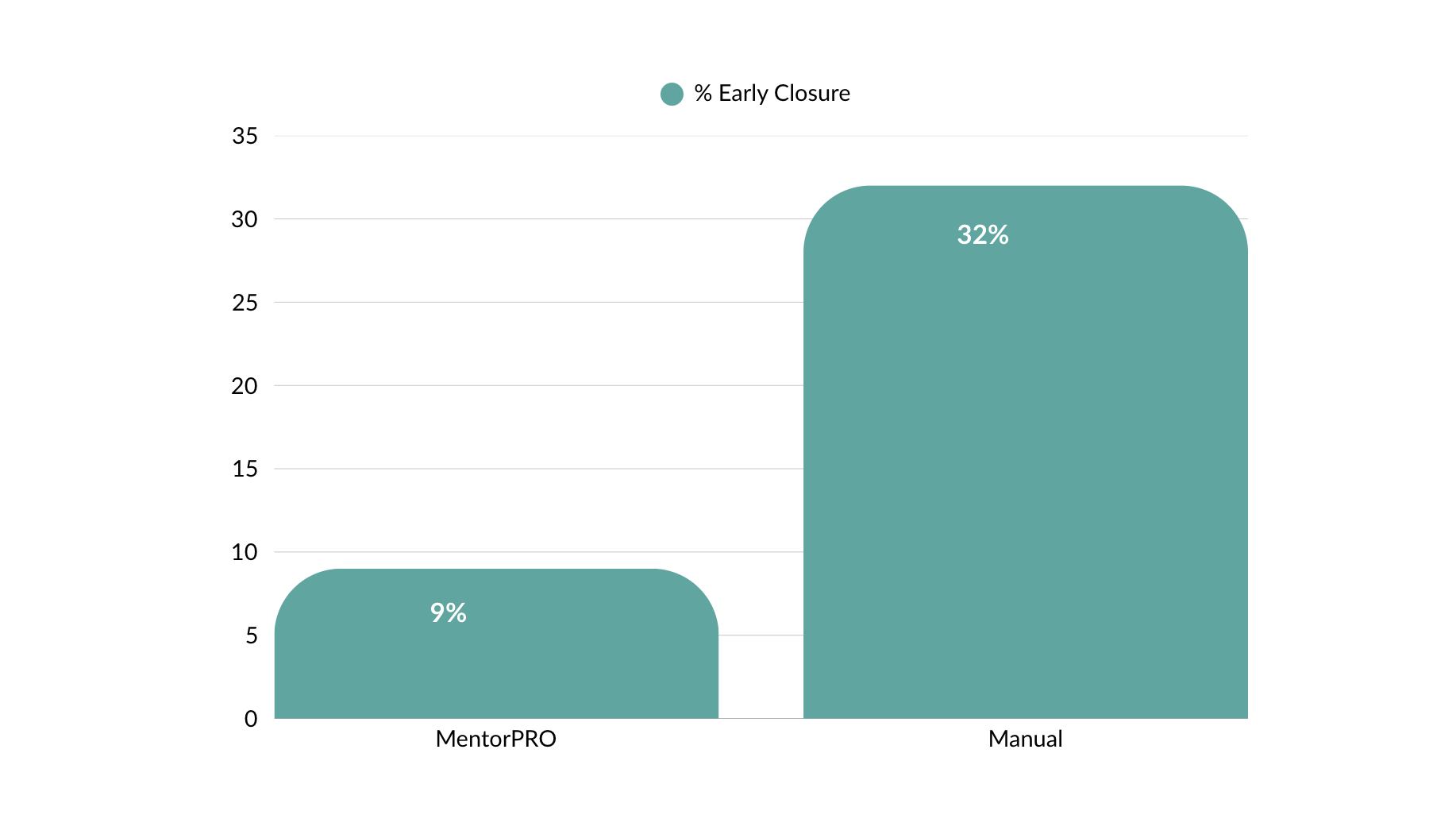
MatchPRO vs. manual assignment
| Criteria | MatchPRO + your coordinators | Manual matching only |
|---|---|---|
| Variables considered | Program preferences plus evidence-based variables | Varies by coordinator experience |
| Consistency | Fully customizable, consistent process | Subject to human variability |
| Scalability | Scales to any program size | Labor-intensive at scale |
| Early match closure (independent data) | 9% | 32% |
| Relationship quality | Higher | Lower |
| Evidence base | Practitioner judgment plus research expertise | Practitioner judgment |
| Coordinator has the final say | Yes | Yes |
Programs that rely on manual matching are not doing something wrong. Experienced coordinators bring real judgment and contextual knowledge to the process, and they always have the final say on any suggested pairing.
But fully manual matching is limited by time, attention, and the number of variables any one person can weigh at once. An algorithm customized to your program's priorities and built on decades of research does not get tired, does not carry unconscious preferences, and does not run out of capacity when a program grows.
MentorPRO gives program coordinators the confidence that their matches are grounded in data, not guesswork.
How MatchPRO matching works
The MatchPRO process is customizable, transparent, and grounded in more than 30 years of research. Programs work with our team to identify the variables that matter most for their population and context. No two programs are identical, and the system is built to reflect that.
- 1Step one
Select
Program managers choose their matching variables from our research-backed library, with the option to add variables specific to their program.
- 2Step two
Customize
MentorPRO generates a customized intake form linked directly to the platform.
- 3Step three
Gather
Mentors and mentees complete the form, and program managers can designate a point person to review submissions.
- 4Step four
Review
Program managers review the recommended matches, confirm pairings, and grant platform access. Pairs can be re-matched in future program cycles as needed.
Frequently asked questions
Is algorithmic matching better than manual matching?
MentorPRO's evidence-based matching produces mentoring relationships that are nearly three times more likely to endure than those formed through manual matching alone. In an independent study of 115 matches, only 9% of MentorPRO-facilitated relationships ended early, compared to 32% in the manually matched group (Rhodes et al., 2026).
What variables does MentorPRO use for matching?
MentorPRO draws on more than 15 research-driven variables, including demographics, language fluency, goals, interests, availability, and program-specific criteria, with particular emphasis on mentee preferences. All variables are customizable in consultation with our team.
Why does matching matter?
Early closure is one of the most well-documented risks in youth mentoring research. Relationships that end prematurely, particularly those that dissolve within the first few months, are associated with negative outcomes for young people, including reduced trust, lower motivation, and in some cases worse outcomes than having no mentor at all. MentorPRO does not just create matches faster. It creates matches that hold.
Can programs of any size use MentorPRO matching?
Yes. MentorPRO's algorithm scales from small cohorts to programs with hundreds of pairs, keeping every match consistent without adding staff workload.
The peer-reviewed research behind MatchPRO
- Ramadurai, R., Deng, Y., Werntz, A., Yowell, C., and Rhodes, J. E. (2025). Mentor-mentee similarity in college peer mentoring: Untangling conflicting results. Studies in Higher Education. https://doi.org/10.1080/03075079.2025.2572504
- Raposa, E. B., Ben-Eliyahu, A., Olsho, L., and Rhodes, J. (2019). Birds of a feather: Is matching based on shared interests and characteristics associated with longer youth mentoring relationships? Journal of Community Psychology, 47(2), 385-397. https://doi.org/10.1002/jcop.22127
- Spencer, R., Gowdy, G., Drew, A. L., and Rhodes, J. E. (2018). "Who knows me the best and can encourage me the most?": Matching and early relationship development in youth-initiated mentoring relationships. Journal of Adolescent Research. https://doi.org/10.1177/0743558417705491
- Kupersmidt, J., Stump, K., Stelter, R., and Rhodes, J. (2017). Predictors of premature match closure in youth mentoring relationships. American Journal of Community Psychology. https://doi.org/10.1002/ajcp.12153
- Kupersmidt, J., Stump, K., Stelter, R., and Rhodes, J. (2017). Mentoring program practices as predictors of match longevity. Journal of Community Psychology. https://doi.org/10.1002/jcop.21883
- Rhodes, J., Schwartz, S., Willis, M. M., and Wu, M. V. (2017). Validating a mentoring relationship quality scale: Does match strength predict match length? Youth and Society, 49(4), 415-437. https://doi.org/10.1177/0044118X14531603
- Grossman, J. B., Chan, C. S., Schwartz, S. E. O., and Rhodes, J. E. (2012). The test of time in school-based mentoring: The role of relationship duration and re-matching on academic outcomes. American Journal of Community Psychology. https://doi.org/10.1007/s10464-011-9435-0
- Kanchewa, S., Rhodes, J. E., Schwartz, S. E. O., and Olsho, L. (2014). The influence of same- versus cross-gender matching in formal youth mentoring programs. Applied Developmental Science. https://doi.org/10.1080/10888691.2014.927358
- Rhodes, J. E., Reddy, R., and Rappaport, N. (2005). Promoting successful youth mentoring relationships: A preliminary screening questionnaire. Journal of Primary Prevention, 26(2), 147-167. https://doi.org/10.1007/s10935-005-1849-y
- Rhodes, J. E., Reddy, R., Grossman, J. B., and Lee, J. M. (2002). Volunteer mentoring relationships with minority youth: An analysis of same- versus cross-race matches. Journal of Applied Social Psychology, 32(10), 2114-2133. https://www.rhodeslab.org/wp-content/uploads/2016/04/rhodes-et-al-2002-same-versus-cross-race-matches.pdf
- Rhodes, J. E. (2020). Older and Wiser: New Ideas for Youth Mentoring in the 21st Century. Harvard University Press. https://www.hup.harvard.edu/books/9780674292277
See MatchPRO with your program's own criteria
We will walk you through the intake form, the match list, and how coordinators review and confirm every pair.