

Most mentoring programs make their most important decision in the first five minutes of a relationship, and then never look at it again.
That decision is the match. Get it right, and a mentor and mentee build the kind of trust that keeps a young person showing up for months or years. Get it wrong, and the pairing quietly stalls out, usually without anyone flagging it until a check-in reveals nobody’s talked in weeks.
If you run a mentoring program at a university, a nonprofit, or a workforce development organization, this post covers what the research actually says about matching for a mentoring program, the best ways to match mentors and mentees, and how mentoring program matching software like MatchPRO turns those best practices into a repeatable process instead of a one-time guess.
See how MatchPRO’s evidence-based matching works
Why matching mentors and mentees well matters more than most programs think
Matching gets treated as an administrative task: collect two intake forms, eyeball them for something in common, assign a pair, move on to the next one. But matching is a core practice standard in the mentoring field, not an afterthought. Dr. Jean Rhodes, MentorPRO’s co-founder, is the author of the Elements of Effective Practice in Mentoring, the standards now used by mentoring programs across the country, and structured matching is one of them.
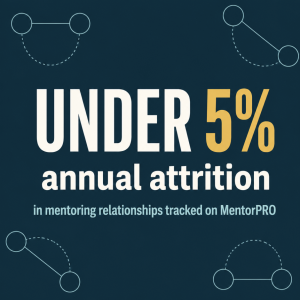
The numbers back up why. In an independent experimental study of 115 matches, only 9% of algorithm-matched relationships ended early, compared to 32% of manually matched ones. Across MentorPRO’s platform, evidence-based matching reduces early match closure by 72% and produces relationships that are roughly three times more likely to endure than those formed through a traditional manual process.
That pattern holds well beyond higher education. Matt Cariani, Director of Education, Research, and Innovation at the National Coffee Association, put it this way after moving his program’s matching onto MentorPRO:
“MentorPRO streamlined what had traditionally been a very time-intensive manual matching process, while delivering strong mentor-mentee pairings that aligned well with participant goals and interests.”
Universities see it too. First-year students at Northeastern who were matched and supported through a structured mentoring platform completed over 17,000 check-ins and sent more than 13,000 messages to their peer mentors in a single year, with higher engagement linked to stronger first-year GPAs. Different sector, same underlying pattern: a match built on data holds up better than one built on a hunch.
What evidence-based matching actually means
“Evidence-based matching” gets used loosely in the mentoring world. For it to mean something, it has to be built from research on what actually predicts a strong pairing, not just whatever fields happened to make it onto an intake form.
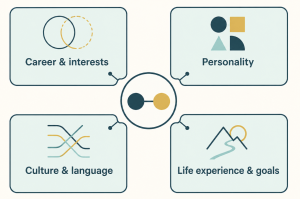
MatchPRO, MentorPRO’s matching tool, was built directly from peer-reviewed research at the Center for Evidence-Based Mentoring, co-founded by Dr. Jean Rhodes, one of the most cited mentoring researchers in the field. The matching algorithm draws on more than 15 research-driven variables, grouped into four categories:
- Career and interests. What a mentee wants out of the relationship professionally or academically, and what a mentor can actually offer on that front.
- Personality. Communication style and temperament, which affect how a pairing feels day to day far more than a shared hobby does.
- Cultural and language factors. Background and language considerations that shape how comfortable a mentee feels opening up.
- Life experience and goals. Where each person has been and where they’re trying to go, which is often a stronger predictor of connection than surface-level similarity.
That last point matters more than it sounds. In one study, Dr. Rhodes’ team matched 2,072 first-year students by major, then looked at what else each pair happened to share. Whether a mentor who was “someone like them” actually helped depended entirely on which student you asked. Similarity on paper is not a substitute for a mentor with the right skills and the right fit for that specific student.
Read more on the research behind MentorPRO
Best ways to match mentors and mentees: what to build into your process
If you’re evaluating how your program matches mentors and mentees today, these are the practices worth checking your process against.
Match on more than one or two variables
A program that matches on major, or on general availability, and calls it done is leaving most of the predictive value on the table. The research points to multiple, weighted variables, not a single shared trait.
Use a structured intake form, not an informal conversation
An intake conversation is easy to run inconsistently from one mentor or mentee to the next. A structured form, applied the same way to every participant, is what makes the matching process comparable and repeatable at scale.
Keep a program manager in the loop before any match goes live
Software can surface the strongest matches based on the data, but a person who knows the program should still review and confirm every pairing before mentor and mentee are introduced. Matching should support judgment, not replace it.
Plan for re-matching from day one
Even a well-built match can need a reset. Programs that treat re-matching as a normal, expected part of the process, rather than a sign of failure, keep participants in the program instead of losing them when a first pairing doesn’t click.
Don’t rely on shared identity as a stand-in for fit
Shared background can help a match. It is not, on its own, a reliable substitute for shared goals, complementary personality, and a mentor with the skills that specific mentee needs. Even MatchPRO’s own intake form separates “same” characteristics like gender, race, and hobbies from “similar” ones like career interests and cultural background for exactly this reason: sameness and fit are not the same question.
See how MentorAI supports mentors after the match is made
How to match a mentoring program step by step
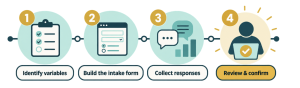
Here’s what a structured, evidence-based matching process looks like from intake to launch, the same four-step process MatchPRO runs for programs on MentorPRO:
- Select. Program managers identify their matching variables from a research-backed library, drawing on more than 15 options across career and interests, personality, cultural and language factors, and life experience and goals, with the option to add variables specific to their own population.
- Customize. MentorPRO generates a structured intake form linked directly to the platform, so every mentor and mentee fills out the same form and every response is comparable.
- Gather. Mentors and mentees complete the form. Program managers can designate a point person to review submissions as they come in, which is the step programs most often shortcut when matching is done by hand.
- Review. Program managers review the algorithm-generated match list, confirm pairings against what they know about each participant, and grant platform access. Pairs can be re-matched in future program cycles as needed.
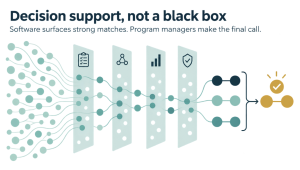
That last step is worth repeating: this is a decision-support process, not an automated black box. The algorithm narrows the field to the strongest possible pairings, weighing more variables at once than any one person reasonably can. A program manager still makes the final call on every match.
Why mentoring program matching software beats spreadsheets and gut feel
Most programs that aren’t using dedicated matching software are running this process in a spreadsheet, or worse, in someone’s memory of who seemed like a good fit during an intake call. That approach doesn’t scale past a handful of pairs, and it leaves no record of why a match was made, which makes it nearly impossible to improve the process over time.

Mentoring program matching software like MatchPRO fixes that by making every match traceable: which variables drove the pairing, who reviewed it, and when. That record is also what turns into the kind of engagement and outcome data programs need for board reporting and funder renewals, the same data behind the 9% early closure rate MentorPRO-matched relationships saw in independent research, against 32% for manually matched pairs.
See how universities and nonprofits use MentorPRO
FAQ
What is evidence-based mentor matching?
Evidence-based mentor matching means pairing mentors and mentees using variables that research has actually linked to strong mentoring relationships, such as personality, life experience, and goals, rather than matching on convenience or a single shared trait like major or availability.
How many variables should a mentoring program use to match mentors and mentees?
There’s no fixed number, but research-backed matching tools like MatchPRO typically draw on more than 15 variables across a handful of categories: career and interests, personality, cultural and language factors, and life experience and goals. More variables generally means a more precise match, as long as the intake data behind them is complete.
Should we match mentors and mentees who share the same background?
Shared background can help, but it isn’t a reliable substitute for fit. Research on matching students by shared identity has found that whether a shared trait helps depends heavily on the individual student, so it’s best treated as one factor among several rather than the deciding one.
Can we re-match a mentor and mentee after the relationship has started?
Yes, and programs should plan for it. Even a carefully built match can need a reset. Treating re-matching as a normal part of the process, not a failure, keeps participants engaged instead of losing them after one pairing that didn’t work out.
Is mentoring matching software only useful for large programs?
No. Smaller programs benefit the same way larger ones do: a structured process is more consistent than an informal one at any scale, and the record it creates becomes useful the moment a funder or board asks how matches are made.
The match is worth getting right
Matching isn’t the paperwork before the mentoring relationship starts. It’s the first and most important decision a program makes about whether that relationship is going to work. Programs that treat it as a research-backed, repeatable process, not a one-time guess, see it in fewer stalled relationships and stronger outcomes down the line.
See how MatchPRO’s evidence-based matching works
Ready to see evidence-based matching in action? Book a 15-minute walkthrough of MatchPRO and see how it fits your program.
Keep reading.

How to Measure ROI on a Mentoring Program
If your mentoring program is grant-funded, reporting is not an afterthought. It is how you keep the funding.
Read more
How Much Does Mentoring Software Cost?
Most mentoring software falls somewhere between roughly $6,000 and $40,000 per year, depending on how many people you are supporting, how many programs you run, and whether training…
Read more
New study sets a higher bar for AI-powered mentoring support
A new study accepted for publication in Translational Issues in Psychological Science (Hersch et al., in press). raises questions about how AI should be used to support mentoring relationships.
Read moreSee MentorPRO built around your program.
Tell us a little about your program and a member of our partner success team will reach out.